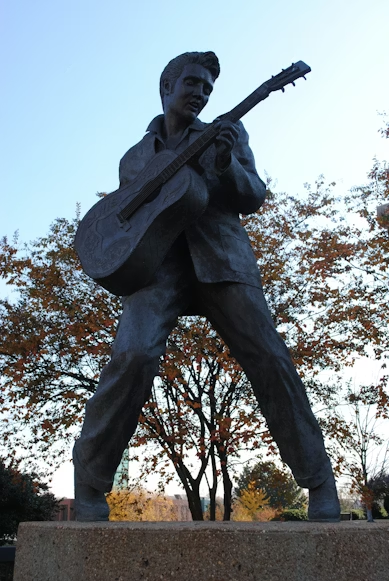
For many people around the world, Elvis Presley is a musical giant — the man who changed the sound, attitude, and soul of modern music. But behind the legend, there was once a shy young man from a modest American town who carried nothing more than a warm heart, a deep love for music, and a dream.
His rise wasn’t inevitable. It was emotional, human, and profoundly humble.

A Quiet Beginning in Tupelo, Mississippi
Elvis Aron Presley was born on January 8, 1935, in the small town of Tupelo in the American South. The region was marked by poverty, slow rhythms of life, and a strong sense of community. His family, especially his mother Gladys, lived through financial hardship and uncertainty during the Depression years.
Growing up in Tupelo meant growing up with very little — but also being surrounded by warmth, hospitality, and the music of everyday life.
Elvis spent his early childhood absorbing the sounds around him: gospel hymns in the local churches, heartfelt country tunes on the radio, and the emotional power of blues coming from African American neighborhoods. These influences didn’t just shape his taste; they shaped his identity.
Even as a boy, Elvis felt music deeply. It wasn’t technical or calculated — it was instinctive, emotional, almost spiritual.
Moving to Memphis: A Turning Point
In 1948, Elvis’s family moved to Memphis, Tennessee, a city with a rich musical tapestry. Memphis was full of life — bustling streets, blues clubs, gospel choirs, and country stations mixing into one unique soundscape.
Memphis would become the birthplace of his transformation.
Elvis attended Humes High School, where he was quiet but kind, polite but different. He stood out because he felt things intensely — through music, through clothes, through expression. He wasn’t trying to be rebellious; he was simply being himself in a world that wasn’t used to that kind of authenticity.
Just a few years later, that authenticity would change everything.
Sun Records: Where History Changed
In 1953, Elvis walked into Sun Records to record a song as a gift for his mother. It was meant to be a private moment — a simple recording from a son who adored his family.
But fate had other plans.
Sam Phillips, the studio’s founder, sensed something different in him. Elvis had a voice that held gospel emotion, blues depth, and country storytelling — all combined in a way no one had heard before.
A year later, in 1954, during a casual studio break, Elvis began playing around with “That’s All Right”. The spontaneous energy of that moment gave birth to a new sound. Raw. Rhythmic. Electric.
A sound that would ignite the rock and roll revolution.
Breaking Through in Mid-1950s America
From 1954 to 1956, Elvis’s career exploded. His voice, his movement, and his charisma were unlike anything the American public had seen. His appearances on national television created a cultural shock. Young fans screamed with excitement; some adults felt confused or threatened by this new form of expression.
This was more than music.
This was a shift in culture, identity, and youth freedom.
Elvis wasn’t trying to provoke. He simply performed with heart — and that honesty resonated deeply with millions.
By the end of the decade, he had become a national phenomenon and a rising international star in the United Kingdom, where British teenagers embraced his sound with passion, and across Germany, where American pop culture was beginning to grow rapidly in the post-war years.
The Military Chapter: Elvis in Germany
In 1958, at the height of his fame, Elvis received his draft notice from the U.S. Army. Instead of seeking special treatment, he made a decision that surprised the world: he would serve as a regular soldier.
His time in Germany became one of the most defining chapters of his life.
Elvis was stationed in Friedberg and lived in Bad Nauheim, two towns that would become central to his personal development. For many Germans, seeing Elvis walk their streets created an unforgettable moment in cultural history — a bridge between American music and European curiosity.
During his stay, Elvis lived away from the spotlight, trained with discipline, and maintained strong ties with fans who waited outside his home each day. His warmth and kindness left a lasting impression in Germany, a country that continues to hold a deep admiration for him.
It was also in Germany that Elvis experienced emotional changes, personal relationships, and a moment of pause in his career — a period that matured him and prepared him for the next phase of his life.
When he returned to the United States in 1960, he came back as a more grounded, disciplined, and emotionally rich man.
The Emotional DNA of Elvis’s Early Life
To truly understand Elvis’s impact — in the U.S., the U.K., and Germany — we must return to the emotional foundations of his youth:
1. Gospel Roots
Raised in churches where emotion poured into every note, Elvis carried that spiritual intensity into his performances.
2. Blues Influence
Elvis absorbed the raw truth of blues from Memphis neighborhoods, blending it into his unique vocal style.
3. Country Storytelling
From childhood radio stations to his early guitar playing, country music taught him warmth, narrative, and sincerity.
4. Southern Hospitality
Living with little, Elvis grew up valuing kindness, family, and humility — traits that fans across the world felt instantly.
These elements combined into a voice and presence that were not manufactured, but lived.
Why Elvis Resonates Globally — Even Today
Elvis is not just an American icon.
He’s a universal figure with international appeal:
- In the United States, he remains a foundational symbol of rock and roll and cultural revolution.
- In the United Kingdom, Elvis inspired entire generations of musicians who later shaped British rock — from local bands to global legends.
- In Germany, his military years and cultural influence created a strong and lasting bond with German fans.
Conclusion: The Soul Behind the Legend
Elvis Presley’s humble beginnings in the 1950s are more than a historical detail — they are the emotional core of the man who became a global icon.
His music grew from sincerity, hardship, spirituality, and a deep human warmth that touched millions.